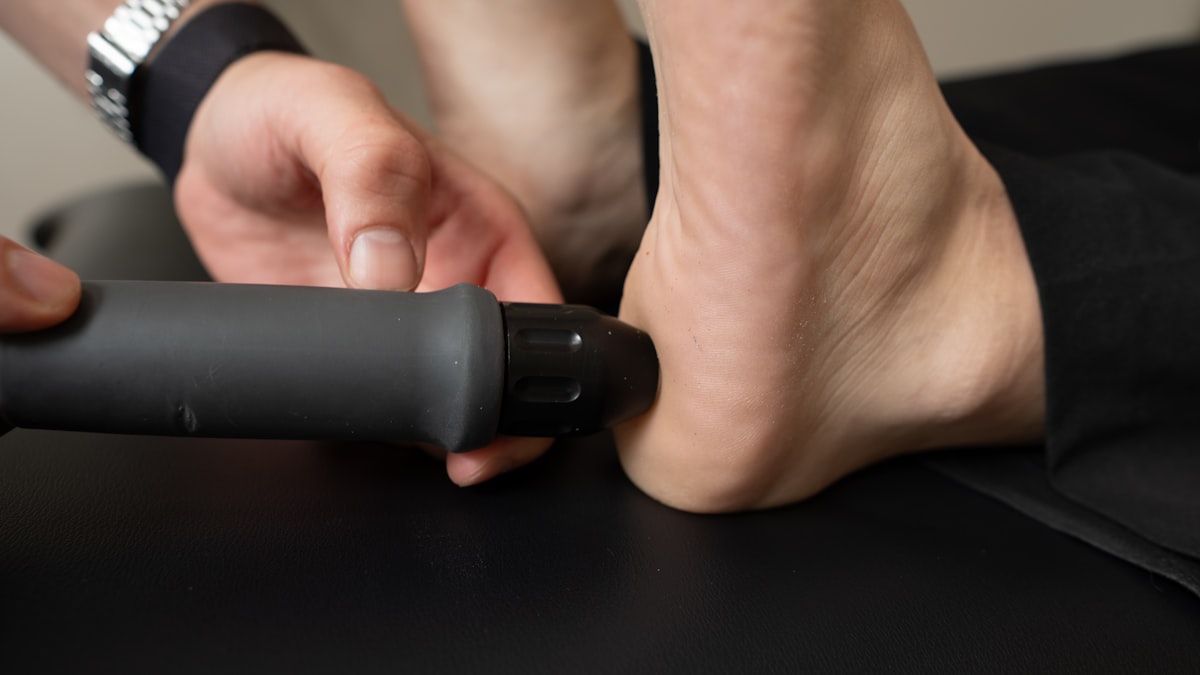
Plantar Fasciitis: Why Months of Stretching Still Fail
You've been stretching every morning for months, but your heel still hurts. A Malaysian physio explains what stretching misses — and how dry needling can help.
One of the most common things I hear in clinic: "I've been stretching every morning for three months. My heel feels okay for an hour, then it's back."
The stretching is working — partly. But plantar fasciitis, especially when it's been there for months, has a component that stretching simply cannot reach.
Why Your Calf and Arch Stretches Aren't Fixing It
Stretching the plantar fascia and calf muscle does something useful: it reduces tension on the insertion point at your heel. That's why it helps, and why clinical guidelines recommend it as first-line treatment.
The problem is that chronic plantar fasciitis — more accurately called plantar fasciopathy, since biopsies show degenerative tissue change rather than active inflammation — involves more than a tight arch. Studies using ultrasound and pressure-pain testing consistently find clusters of myofascial trigger points in the intrinsic muscles of the foot and the calf. These are small, contracted knots of muscle fibre that generate pain independently of how tight or loose the fascia itself is.
Research published in Pain Medicine found that patients with chronic plantar heel pain had an average of four active trigger points in muscles like the flexor hallucis brevis, quadratus plantae, and gastrocnemius — and the more active trigger points, the worse the pain scores. When a physio applies pressure to these points, patients often feel a referred ache right in the heel. The same heel pain, produced by a muscle knot nowhere near the heel.
Stretching lengthens the fascial chain. It doesn't deactivate trigger points. That gap explains why so many people get partial relief from stretching — and why that relief stays partial.
Why Plantar Fasciitis Is So Hard to Shake in Malaysia
A few things about everyday life in Malaysia make this condition harder to resolve than it should be.
Flat footwear at home is probably the biggest factor. After a long day at work, most of us slip off our shoes at the door and walk barefoot or in flat flip-flops on ceramic tile. That tile gives no cushioning. Those selipar give no arch support. The fascia loads with every step, with nothing absorbing the impact.
Add standing occupations — hawker stall work, nursing, teaching — often on concrete or wet tile for six to ten hours, and you have a recipe for the tissue never fully recovering between days. Tight calf muscles compound this: wearing flat footwear long-term reduces the load on your gastrocnemius, which shortens it over time. A tight gastrocnemius increases the pull on the plantar fascia with every step you take.
The result is a cycle that stretching alone rarely breaks: the fascia and surrounding muscles are under load from morning to night, with no genuine recovery window, and the trigger points that have built up continue generating pain on their own timetable.
What Dry Needling Targets — and What the Research Shows
Dry needling uses thin acupuncture-style needles to target those myofascial trigger points directly — in the intrinsic foot muscles and, critically, in the gastrocnemius and soleus of the calf. When the needle reaches an active trigger point, it produces a brief involuntary muscle twitch. That twitch discharges the contracted muscle fibres, improves local blood flow, and reduces the chemical mediators that keep the trigger point sensitised.
A 2024 systematic review in Frontiers in Neurology, pooling 12 randomised controlled trials and 781 patients, found that adding dry needling to standard treatment produced significantly greater pain reduction than standard treatment alone. It also outperformed other standalone treatments — including shockwave therapy — specifically on measures of foot function.
That last point matters. Many patients arrive having already tried cortisone injections or shockwave therapy. Dry needling works through a different mechanism, and combining it with structured exercise consistently outperforms either approach on its own.
In one multicentre trial involving 111 participants, 78% of patients who received dry needling alongside physiotherapy exercise achieved a successful outcome at three months. In the exercise-only group, that figure was 21%. The dry needling wasn't replacing the exercise — it was addressing the trigger point component that exercise alone couldn't reach.
What Treatment Looks Like — and How Long to Expect
One session of dry needling won't fix months of built-up fasciopathy. The research is fairly consistent: meaningful pain reduction takes at least four weeks of regular treatment.
A typical course at our clinic combines:
- Dry needling to the foot muscles and calf (the posterior chain from knee to heel matters as much as the foot itself)
- A progressive loading programme — heel raises with toe extension, which loads the plantar fascia in a way that drives tissue remodelling
- Footwear guidance and modifications for your home environment
- Taping for pain management between sessions when needed
Most patients need four to six sessions over four to six weeks before seeing consistent change. Some soreness in the first day or two after needling is normal — it's a sign the tissue is responding, not that something has gone wrong. By weeks three to four, most patients notice a significant reduction in that first-step morning pain.
If your heel has been bothering you for more than six weeks despite regular stretching, that's a reasonable signal to come in. There's a myofascial component that a physio can assess and treat — and it's often the piece that, once addressed, finally lets the stretching do what it was supposed to all along.
To book a heel pain assessment at Pinpoint Physiotherapy in Subang Jaya, send us a message on WhatsApp.
Related articles.
If this piece helped, these will too.
Pain After Dry Needling: Why You Feel Worse Before You Feel Better
Woke up more sore after dry needling? Here's exactly why that happens, what's normal, what isn't, and how to recover faster — from a Malaysian physio.

Pelvic Floor After Birth: What Pantang Doesn't Fix
Nearly half of Malaysian mothers experience pelvic floor problems after birth. Pantang helps you rest — but it won't fix leaking, pain, or diastasis recti.
Bahu Beku (Frozen Shoulder): Kenapa Menunggu Memanjangkan Pemulihan Anda
Bahu beku boleh ambil masa 3 tahun tanpa rawatan. Fisioterapi di Petaling Jaya terangkan tiga peringkat frozen shoulder dan kenapa rawatan awal potong masa tu kepada 3–6 bulan.
Book an assessment.
60 minutes. One-to-one with Felicia. Reply on WhatsApp within a few hours.
Message on WhatsApp